Top central bank official points to strong recovery in US economic activity and consumer spending Mary Daly, San Francisco Fed president, is a member of the policy-setting Federal Open Market Committee © REUTERS Share on twitter (opens new window) Share on facebook (opens new window) Share on linkedin (opens new window) Share Save Colby Smith in New York AUGUST 12 2021 2 Print this page Be the first to know about every new Coronavirus story Get instant email alerts The Federal Reserve could start dialling back its ultra-accommodative monetary stimulus by the end of the year, given the strength of the economic rebound, according to a top official at the US central bank. In an interview with the Financial Times, Mary Daly, president of the San Francisco Fed, expressed confidence that the robust recovery in household and business activity from the depths of the Covid-19 collapse would continue to gather momentum as more people returned to the workforce and consumer spending remained buoyant, setting the stage for a policy pivot in the coming months. “I remain very optimistic and positive about the fall and ongoing improvements in the key variables we care about,” she said on Wednesday. “That for me means it’s appropriate to start discussing dialling back the level of accommodation that we’re giving the economy on a regular basis, and the starting point for that is of course asset purchases. “Talking about potentially tapering those later this year or early next year is where I’m at,” said Daly, who has long been one of the more “dovish” members of the Fed advocating for a patient approach to withdrawing support. The Fed has said it would continue buying $120bn of agency mortgage-backed securities and Treasuries each month until it achieved “substantial further progress” on its goals of 2 per cent inflation on average and maximum employment. Coronavirus business update How is coronavirus taking its toll on markets, business, and our everyday lives and workplaces? Stay briefed with our coronavirus newsletter. Sign up here Daly, who is a voting member on the policy-setting Federal Open Market Committee, said that those thresholds would likely be met by the end of the year or early on in 2022. Her comments followed another elevated inflation reading on Wednesday, which showed year-on-year price gains were holding steady at 5.4 per cent, even though the increase from last month registered a more moderate pace. Some sectors more sensitive to pandemic disruptions saw slower price rises than in previous months, too. The labour market has also made significant strides, with 943,000 jobs added in July. The unemployment rate ticked down to 5.4 per cent from 5.9 per cent in June. “We’re really adding enough jobs to see that we’re making progress towards our full employment goal,” said Daly. “We’re not there yet . . . [but] we’re chipping away at the hole that was dug by Covid.” Nearly 6m more Americans remain out of work than in February 2020. Daly said she expected the shortfall would shrinks as pandemic fears faded, childcare issues were resolved and enhanced unemployment benefits were phased out. The improving economic backdrop has catalysed a vigorous debate among Fed officials about the appropriate pace to remove its support. The past week has marked a turning point, with a growing number of central bankers making the case for a swifter retreat from financial markets than many initially expected. On Wednesday, Esther George, president of the Kansas City Fed and who will be a voting member of the committee in 2022, said it was time to “transition from extraordinary monetary policy accommodation to more neutral settings”. “While recognising that special factors account for much of the current spike in inflation, the expectation of continued strong demand, a recovering labour market and firm inflation expectations are consistent, in my view, with the committee’s guidance regarding substantial further progress toward its objectives,” George said at a seminar organised by the National Association for Business Economics. “I support bringing asset purchases to an end under these conditions.” Her views align closely with those of James Bullard, president of the St Louis Fed, and Robert Kaplan of the Dallas Fed, who said in an interview with CNBC on Wednesday that he supported announcing in September that tapering would begin in October. That is also in line with the timeline put forward by Fed governor Christopher Waller earlier this month, so long as upcoming jobs data remain solid. Recommended FT AlphavilleClaire Jones At what point does inflation really start to matter? Raphael Bostic from the Atlanta Fed, Eric Rosengren of the Boston Fed and Thomas Barkin, Richmond Fed president, also weighed in this week, each making the case that inflation was already where it needed to be in order to begin winding down bond purchases. The principal risk to the outlook, according to Fed officials, is the alarming spread of the more contagious Delta coronavirus variant — although Daly said it was likely to have a limited economic impact. “Overall, I don’t think it will derail our recovery,” she said.
Thursday, August 12, 2021
Tapering of asset purchases could start as soon as this year, says Fed’s Daly
Top central bank official points to strong recovery in US economic activity and consumer spending Mary Daly, San Francisco Fed president, is a member of the policy-setting Federal Open Market Committee © REUTERS Share on twitter (opens new window) Share on facebook (opens new window) Share on linkedin (opens new window) Share Save Colby Smith in New York AUGUST 12 2021 2 Print this page Be the first to know about every new Coronavirus story Get instant email alerts The Federal Reserve could start dialling back its ultra-accommodative monetary stimulus by the end of the year, given the strength of the economic rebound, according to a top official at the US central bank. In an interview with the Financial Times, Mary Daly, president of the San Francisco Fed, expressed confidence that the robust recovery in household and business activity from the depths of the Covid-19 collapse would continue to gather momentum as more people returned to the workforce and consumer spending remained buoyant, setting the stage for a policy pivot in the coming months. “I remain very optimistic and positive about the fall and ongoing improvements in the key variables we care about,” she said on Wednesday. “That for me means it’s appropriate to start discussing dialling back the level of accommodation that we’re giving the economy on a regular basis, and the starting point for that is of course asset purchases. “Talking about potentially tapering those later this year or early next year is where I’m at,” said Daly, who has long been one of the more “dovish” members of the Fed advocating for a patient approach to withdrawing support. The Fed has said it would continue buying $120bn of agency mortgage-backed securities and Treasuries each month until it achieved “substantial further progress” on its goals of 2 per cent inflation on average and maximum employment. Coronavirus business update How is coronavirus taking its toll on markets, business, and our everyday lives and workplaces? Stay briefed with our coronavirus newsletter. Sign up here Daly, who is a voting member on the policy-setting Federal Open Market Committee, said that those thresholds would likely be met by the end of the year or early on in 2022. Her comments followed another elevated inflation reading on Wednesday, which showed year-on-year price gains were holding steady at 5.4 per cent, even though the increase from last month registered a more moderate pace. Some sectors more sensitive to pandemic disruptions saw slower price rises than in previous months, too. The labour market has also made significant strides, with 943,000 jobs added in July. The unemployment rate ticked down to 5.4 per cent from 5.9 per cent in June. “We’re really adding enough jobs to see that we’re making progress towards our full employment goal,” said Daly. “We’re not there yet . . . [but] we’re chipping away at the hole that was dug by Covid.” Nearly 6m more Americans remain out of work than in February 2020. Daly said she expected the shortfall would shrinks as pandemic fears faded, childcare issues were resolved and enhanced unemployment benefits were phased out. The improving economic backdrop has catalysed a vigorous debate among Fed officials about the appropriate pace to remove its support. The past week has marked a turning point, with a growing number of central bankers making the case for a swifter retreat from financial markets than many initially expected. On Wednesday, Esther George, president of the Kansas City Fed and who will be a voting member of the committee in 2022, said it was time to “transition from extraordinary monetary policy accommodation to more neutral settings”. “While recognising that special factors account for much of the current spike in inflation, the expectation of continued strong demand, a recovering labour market and firm inflation expectations are consistent, in my view, with the committee’s guidance regarding substantial further progress toward its objectives,” George said at a seminar organised by the National Association for Business Economics. “I support bringing asset purchases to an end under these conditions.” Her views align closely with those of James Bullard, president of the St Louis Fed, and Robert Kaplan of the Dallas Fed, who said in an interview with CNBC on Wednesday that he supported announcing in September that tapering would begin in October. That is also in line with the timeline put forward by Fed governor Christopher Waller earlier this month, so long as upcoming jobs data remain solid. Recommended FT AlphavilleClaire Jones At what point does inflation really start to matter? Raphael Bostic from the Atlanta Fed, Eric Rosengren of the Boston Fed and Thomas Barkin, Richmond Fed president, also weighed in this week, each making the case that inflation was already where it needed to be in order to begin winding down bond purchases. The principal risk to the outlook, according to Fed officials, is the alarming spread of the more contagious Delta coronavirus variant — although Daly said it was likely to have a limited economic impact. “Overall, I don’t think it will derail our recovery,” she said.

Thursday, March 25, 2021
Banks, energy stocks drag Wall St lower; Biden's presser in focus
(Reuters) - Wall Street's main indexes fell on Thursday, dragged down by economically sensitive bank and energy stocks and shrugging off data showing the labor market continued to limp out of a coronavirus-induced recession.
The Labor Department's weekly jobless claims report, the most timely indicator of economic health, showed fewer-than-expected Americans filed new claims for state unemployment benefits last week.
Ten of the 11 S&P sectors fell in early trading with energy, industrials and financials stocks, which recently came into favor on recovery hopes, declining the most.
"The entire market is sort of shortsighted, focused more on the recent run and completely forgetting about the improving outlook," said Robert Pavlik, senior portfolio manager at Dakota Wealth in New York.
The technology-heavy Nasdaq Composite has fallen in March after four straight months of gains as rosy economic projections lifted demand for undervalued cyclical stocks, but also raised fears of higher inflation and a potential tax hike.
In testimonies to Congress this week, Federal Reserve Chair Jerome Powell expressed optimism about a strong U.S. economic rebound, while Treasury Secretary Janet Yellen said future tax hikes will be needed to pay for public investments.
President Joe Biden is expected to lay out a new goal for U.S. vaccinations against COVID-19 at his first formal White House news conference beginning at 1:15 p.m. ET (1715 GMT). Next week, he is also set to unveil a multitrillion-dollar infrastructure plan in Pittsburgh.
"It's a tale of two different markets at this point and it depends on what the market wants to focus on," said Faron Daugs, founder and chief executive officer of Harrison Wallace Financial Group.
"Does it want to focus on stimulus, increased vaccinations and re-opening economies or on potential taxes, increased regulation potentially in certain sectors, extremely high spending and inflation."
Heavyweight tech stocks Facebook Inc (NASDAQ:FB), Google parent Alphabet (NASDAQ:GOOGL) Inc and Twitter Inc (NYSE:TWTR) were subdued ahead of their chief executives' testimony before Congress about extremism and misinformation on their services.
At 9:57 a.m. ET, the Dow Jones Industrial Average was down 176.61 points, or 0.54%, at 32,243.45, the S&P 500 was down 13.58 points, or 0.35%, at 3,875.56, and the Nasdaq Composite was down 45.37 points, or 0.35%, at 12,916.52.
Shares of Nike Inc (NYSE:NKE) fell 4.8% as the sporting goods giant faced a Chinese social media backlash over its comments about reports of forced labor in Xinjiang.
Darden Restaurants Inc (NYSE:DRI) added 4.1% after it announced new share buyback plan and forecast upbeat fourth-quarter revenue and profit.
Market participants also warned of higher volatility ahead of the quarter-end portfolio rebalancing by institutional investors.
Declining issues outnumbered advancers 3.75-to-1 on the NYSE and 3.39-to-1 on the Nasdaq.
The S&P index recorded one new 52-week high and no new low, while the Nasdaq recorded 11 new highs and 107 new lows.
Monday, August 3, 2020
U.S. Markets Rise With Europe as Earnings Come in Strong
Investing.com -- U.S. stock markets began August where they left off in July, opening higher on the first trading day of the month.
Tech shares led the advance as Microsoft (NASDAQ:MSFT) continued its pursuit of TikTok, this time with presidential approval. Marathon Petroleum (NYSE:MPC) rose 2% after saying it will sell its gas stations for $21 billion.
The positive sentiment in equity markets continued despite the ongoing pandemic and a lack of certainty on the prospects for a fiscal coronavirus relief deal. Investors also seem to be setting aside increased tensions with Beijing, most recently over a possible ban of TikTok and other Chinese software companies.
By 10:04 AM ET (1404 GMT), the Dow Jones Industrial Average was up 218 points or 0.83%. The S&P 500 was up 0.8% and the Nasdaq Composite was up 1.35%.
Eli Lilly (NYSE:LLY) rose more than 2% after saying it will begin testing its Covid-19 drug in nursing homes
U.S. Markets Rise With Europe as Earnings Come in Strong
Saturday, September 29, 2018
Euro Q4 Forecast: Euro Stabilization in Q3 May Offer Base for a Rally in Q4
After persistent selling in the second quarter, the Euro was able to stabilize through the third quarter. Contributing to that balance was the market’s belief of resolution – at least , on the path to resolution – for concerns over the region’s growth, the trajectory of European Central Bank monetary policy, and the budgetary plans of the populist Italian government.

Insofar as we held a neutral outlook for the Euro in the past quarter, we are slightly more optimistic on the Euro’s potential for the final three months. Trading conditions are expected to remain choppy, but directionally, Euro rates should be biased to the topside.
EUR/USD Price Chart: Daily Timeframe (September 2017 to September 2018) (Chart 1)
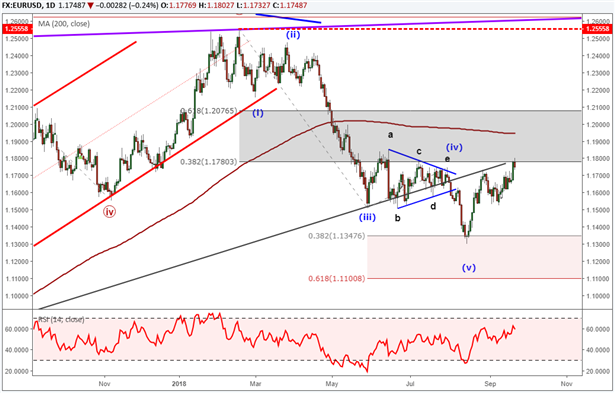
Recently, EUR/USD completed a bearish impulse wave from the February 2018-high to the August 2018-low. Conversely, a three-year up wave ended in April for EUR/CHF; therefore, anticipate a multi-quarter down wave at large degree to work down towards 1.0800 over time. Meanwhile, the Elliott Wave picture for EUR/JPY has muddied a bit, and the consolidation in EUR/GBP hints we are in a large Elliott Wave triangle pattern that may take several more months to complete. The EUR-complex forecast is longer-term bearish, though near-term appreciation may take place in Q4’18.
Wednesday, September 26, 2018
Iran nuclear deal: Key details

In 2015, Iran agreed a long-term deal on its nuclear programme with the P5+1 group of world powers - the US, UK, France, China, Russia and Germany.
It came after years of tension over Iran's alleged efforts to develop a nuclear weapon. Iran insisted that its nuclear programme was entirely peaceful, but the international community did not believe that.
Under the accord, Iran agreed to limit its sensitive nuclear activities and allow in international inspectors in return for the lifting of crippling economic sanctions.
Here are the commitments set out in the Joint Comprehensive Plan of Action.

Enriched uranium is used to make reactor fuel, but also nuclear weapons.
Iran had two facilities - Natanz and Fordo - where uranium hexafluoride gas was fed into centrifuges to separate out the most fissile isotope, U-235.
Low-enriched uranium, which has a 3%-4% concentration of U-235, can be used to produce fuel for nuclear power plants. "Weapons-grade" uranium is 90% enriched.
In July 2015, Iran had almost 20,000 centrifuges. Under the JCPOA, it was limited to installing no more than 5,060 of the oldest and least efficient centrifuges at Natanz until 2026 - 15 years after the deal's "implementation day" in January 2016.

Iran's uranium stockpile was reduced by 98% to 300kg (660lbs), a figure that must not be exceeded until 2031. It must also keep the stockpile's level of enrichment at 3.67%.
By January 2016, Iran had drastically reduced the number of centrifuges installed at Natanz and Fordo, and shipped tonnes of low-enriched uranium to Russia.
In addition, research and development must take place only at Natanz and be limited until 2024.
No enrichment will be permitted at Fordo until 2031, and the underground facility will be converted into a nuclear, physics and technology centre. The 1,044 centrifuges at the site will produce radioisotopes for use in medicine, agriculture, industry and science.

Iran had been building a heavy-water nuclear facility near the town of Arak. Spent fuel from a heavy-water reactor contains plutonium suitable for a nuclear bomb.
World powers had originally wanted Arak dismantled because of the proliferation risk. Under an interim nuclear deal agreed in 2013, Iran agreed not to commission or fuel the reactor.
Under the JCPOA, Iran said it would redesign the reactor so it could not produce any weapons-grade plutonium, and that all spent fuel would be sent out of the country as long as the modified reactor exists.
Iran will not be permitted to build additional heavy-water reactors or accumulate any excess heavy water until 2031.

At the time of the agreement, then-US President Barack Obama's administration expressed confidence that the JCPOA would prevent Iran from building a nuclear programme in secret. Iran, it said, had committed to "extraordinary and robust monitoring, verification, and inspection".
Inspectors from the International Atomic Energy Agency (IAEA), the global nuclear watchdog, continuously monitor Iran's declared nuclear sites and also verify that no fissile material is moved covertly to a secret location to build a bomb.
Iran also agreed to implement the Additional Protocol to their IAEA Safeguards Agreement, which allows inspectors to access any site anywhere in the country they deem suspicious.
Until 2031, Iran will have 24 days to comply with any IAEA access request. If it refuses, an eight-member Joint Commission - including Iran - will rule on the issue. It can decide on punitive steps, including the reimposition of sanctions. A majority vote by the commission suffices.

Before July 2015, Iran had a large stockpile of enriched uranium and almost 20,000 centrifuges, enough to create eight to 10 bombs, according to the Obama administration.
US experts estimated then that if Iran had decided to rush to make a bomb, it would take two to three months until it had enough 90%-enriched uranium to build a nuclear weapon - the so-called "break-out time".
The Obama administration said the JCPOA would remove the key elements Iran would need to create a bomb and increase its break-out time to one year or more.
Iran also agreed not to engage in activities, including research and development, which could contribute to the development of a nuclear bomb.
In December 2015, the IAEA's board of governors voted to end its decade-long investigation into the possible military dimensions of Iran's nuclear programme.
The agency's director-general, Yukiya Amano, said the report concluded that until 2003 Iran had conducted "a co-ordinated effort" on "a range of activities relevant to the development of a nuclear explosive device". Iran continued with some activities until 2009, but after that there were "no credible indications" of weapons development, he added.

Sanctions previously imposed by the UN, US and EU in an attempt to force Iran to halt uranium enrichment crippled its economy, costing the country more than $160bn (£118bn) in oil revenue from 2012 to 2016 alone.
Under the deal, Iran gained access to more than $100bn in assets frozen overseas, and was able to resume selling oil on international markets and using the global financial system for trade.
Should Iran violate any aspect of the deal, the UN sanctions will automatically "snap back" into place for 10 years, with the possibility of a five-year extension.
If the Joint Commission cannot resolve a dispute, it will be referred to the UN Security Council.
Iran also agreed to the continuation of the UN arms embargo on the country for up to five years, although it could end earlier if the IAEA is satisfied that its nuclear programme is entirely peaceful. A UN ban on the import of ballistic missile technology will also remain in place for up to eight years.
Trump urges UN to stop Iran getting nuclear bomb

US President Donald Trump has urged other members of the UN Security Council to work with America to ensure Iran never acquires a nuclear bomb.
Chairing a session on weapons of mass destruction, he defended re-imposing sanctions on Iran because of its "malign conduct".
He accused Iran and Russia of "enabling" "butchery" in Syria.
However he also thanked all three countries for pulling back from an offensive against rebels in Idlib.
Are ICO Bounties Actually Good
One of the more popular trends to emerge in the past year is the ICO bounty program, which rewards users and community members for participating in a variety of activities that help push development and marketing forward. ICO bounties are excellent ways to foster a larger and more engaged community, but they can also be a costly endeavor depending on the extent and reach of the program. Moreover, some industry observers have questioned the real-world value of such programs on the tokens they’re meant to support.
Recently, Element Group, a full-service advisory firm that works with digital capital markets, performed a study to determine how effective ICO bounties truly are when going past the anecdotal evidence available online. Their research model studied over 160 ICOs and found some interesting signs that bounties may be here to stay, and for good reason. Regardless, the study does prompt important questions about ICO bounties and how they may look and act moving forward.
Adding Value To The Community
The argument for ICO bounty programs is that they are an easier way to create goodwill and build organic word-of-mouth reach as they involve not a pricey marketing machine, but rather community members themselves. Bounty programs are multi-faceted and cover a variety of bases for an ICO, ranging from social media and blog posts to Telegram communications and even bug reporting. The goal is to reward community members who participate with tokens, providing companies with a cost-effective strategy for reaching broader audiences.

Moreover, bounty programs can be cleanly characterized in pre-ICO and post-ICO categories, giving companies different tools at each phase. Until now, it has been commonly accepted that these programs do add some value. Even so, there are some risks in the process, and ways that the system can be abused by both community members and companies themselves.
Regardless, Element Group, which offers a variety of services for tokenized companies, wanted to understand the real impact of an ICO bounty program on a company’s fundraising performance over the long term. Thanks to their blend of advisory and research services, the company is uniquely positioned to understand the phenomenon. In their initial scan of the sector, Element found anecdotal evidence of increased awareness for ICOs, as well the possibility of improved funding as a result.
To test their initial findings, Element built a model based on stratified sampling that selected 164 ICOs between late 2017 and early 2018. Excluded from the sample were companies that raised under $1 million and those whose bounty allocations were under $10,000. They also ignored companies that placed a disproportionate number of tokens (over $1 million), as they are generally considered outliers. The goal was to find a correlation between dollars spent on bounties and the amount of funding raised during the ICO process.
Subscribe to:
Comments (Atom)
-
What is a 'Leverage Ratio' Companies rely on a mixture of owners equity and debt to finance their operations. A leverage ratio is...
-
 Gold continues to stay in a very narrow range, building towards a breakout while WTI crude oil prices continue to march on higher towar...

