amazon

https://www.taucoin.io/account/login?referralURL=abfb815ddf27cfcb5375ee15ce41b6819eefa3c62700d02aab756225b4814d46

Wednesday, September 26, 2018

Iran nuclear deal: Key details

In 2015, Iran agreed a long-term deal on its nuclear programme with the P5+1 group of world powers - the US, UK, France, China, Russia and Germany.
It came after years of tension over Iran's alleged efforts to develop a nuclear weapon. Iran insisted that its nuclear programme was entirely peaceful, but the international community did not believe that.
Under the accord, Iran agreed to limit its sensitive nuclear activities and allow in international inspectors in return for the lifting of crippling economic sanctions.
Here are the commitments set out in the Joint Comprehensive Plan of Action.
Enriched uranium is used to make reactor fuel, but also nuclear weapons.
Iran had two facilities - Natanz and Fordo - where uranium hexafluoride gas was fed into centrifuges to separate out the most fissile isotope, U-235.
Low-enriched uranium, which has a 3%-4% concentration of U-235, can be used to produce fuel for nuclear power plants. "Weapons-grade" uranium is 90% enriched.
In July 2015, Iran had almost 20,000 centrifuges. Under the JCPOA, it was limited to installing no more than 5,060 of the oldest and least efficient centrifuges at Natanz until 2026 - 15 years after the deal's "implementation day" in January 2016.


Iran's uranium stockpile was reduced by 98% to 300kg (660lbs), a figure that must not be exceeded until 2031. It must also keep the stockpile's level of enrichment at 3.67%.
By January 2016, Iran had drastically reduced the number of centrifuges installed at Natanz and Fordo, and shipped tonnes of low-enriched uranium to Russia.
In addition, research and development must take place only at Natanz and be limited until 2024.
No enrichment will be permitted at Fordo until 2031, and the underground facility will be converted into a nuclear, physics and technology centre. The 1,044 centrifuges at the site will produce radioisotopes for use in medicine, agriculture, industry and science.

Iran had been building a heavy-water nuclear facility near the town of Arak. Spent fuel from a heavy-water reactor contains plutonium suitable for a nuclear bomb.
World powers had originally wanted Arak dismantled because of the proliferation risk. Under an interim nuclear deal agreed in 2013, Iran agreed not to commission or fuel the reactor.
Under the JCPOA, Iran said it would redesign the reactor so it could not produce any weapons-grade plutonium, and that all spent fuel would be sent out of the country as long as the modified reactor exists.
Iran will not be permitted to build additional heavy-water reactors or accumulate any excess heavy water until 2031.
At the time of the agreement, then-US President Barack Obama's administration expressed confidence that the JCPOA would prevent Iran from building a nuclear programme in secret. Iran, it said, had committed to "extraordinary and robust monitoring, verification, and inspection".
Inspectors from the International Atomic Energy Agency (IAEA), the global nuclear watchdog, continuously monitor Iran's declared nuclear sites and also verify that no fissile material is moved covertly to a secret location to build a bomb.
Iran also agreed to implement the Additional Protocol to their IAEA Safeguards Agreement, which allows inspectors to access any site anywhere in the country they deem suspicious.
Until 2031, Iran will have 24 days to comply with any IAEA access request. If it refuses, an eight-member Joint Commission - including Iran - will rule on the issue. It can decide on punitive steps, including the reimposition of sanctions. A majority vote by the commission suffices.
Before July 2015, Iran had a large stockpile of enriched uranium and almost 20,000 centrifuges, enough to create eight to 10 bombs, according to the Obama administration.
US experts estimated then that if Iran had decided to rush to make a bomb, it would take two to three months until it had enough 90%-enriched uranium to build a nuclear weapon - the so-called "break-out time".
The Obama administration said the JCPOA would remove the key elements Iran would need to create a bomb and increase its break-out time to one year or more.
Iran also agreed not to engage in activities, including research and development, which could contribute to the development of a nuclear bomb.
In December 2015, the IAEA's board of governors voted to end its decade-long investigation into the possible military dimensions of Iran's nuclear programme.
The agency's director-general, Yukiya Amano, said the report concluded that until 2003 Iran had conducted "a co-ordinated effort" on "a range of activities relevant to the development of a nuclear explosive device". Iran continued with some activities until 2009, but after that there were "no credible indications" of weapons development, he added.


Sanctions previously imposed by the UN, US and EU in an attempt to force Iran to halt uranium enrichment crippled its economy, costing the country more than $160bn (£118bn) in oil revenue from 2012 to 2016 alone.
Under the deal, Iran gained access to more than $100bn in assets frozen overseas, and was able to resume selling oil on international markets and using the global financial system for trade.
Should Iran violate any aspect of the deal, the UN sanctions will automatically "snap back" into place for 10 years, with the possibility of a five-year extension.
If the Joint Commission cannot resolve a dispute, it will be referred to the UN Security Council.
Iran also agreed to the continuation of the UN arms embargo on the country for up to five years, although it could end earlier if the IAEA is satisfied that its nuclear programme is entirely peaceful. A UN ban on the import of ballistic missile technology will also remain in place for up to eight years.

Trump urges UN to stop Iran getting nuclear bomb

US President Donald Trump has urged other members of the UN Security Council to work with America to ensure Iran never acquires a nuclear bomb.
Chairing a session on weapons of mass destruction, he defended re-imposing sanctions on Iran because of its "malign conduct".
He accused Iran and Russia of "enabling" "butchery" in Syria.
However he also thanked all three countries for pulling back from an offensive against rebels in Idlib.

Are ICO Bounties Actually Good

One of the more popular trends to emerge in the past year is the ICO bounty program, which rewards users and community members for participating in a variety of activities that help push development and marketing forward. ICO bounties are excellent ways to foster a larger and more engaged community, but they can also be a costly endeavor depending on the extent and reach of the program. Moreover, some industry observers have questioned the real-world value of such programs on the tokens they’re meant to support.
Recently, Element Group, a full-service advisory firm that works with digital capital markets, performed a study to determine how effective ICO bounties truly are when going past the anecdotal evidence available online. Their research model studied over 160 ICOs and found some interesting signs that bounties may be here to stay, and for good reason. Regardless, the study does prompt important questions about ICO bounties and how they may look and act moving forward.

Adding Value To The Community

The argument for ICO bounty programs is that they are an easier way to create goodwill and build organic word-of-mouth reach as they involve not a pricey marketing machine, but rather community members themselves. Bounty programs are multi-faceted and cover a variety of bases for an ICO, ranging from social media and blog posts to Telegram communications and even bug reporting. The goal is to reward community members who participate with tokens, providing companies with a cost-effective strategy for reaching broader audiences.


Moreover, bounty programs can be cleanly characterized in pre-ICO and post-ICO categories, giving companies different tools at each phase. Until now, it has been commonly accepted that these programs do add some value. Even so, there are some risks in the process, and ways that the system can be abused by both community members and companies themselves.
Regardless, Element Group, which offers a variety of services for tokenized companies, wanted to understand the real impact of an ICO bounty program on a company’s fundraising performance over the long term. Thanks to their blend of advisory and research services, the company is uniquely positioned to understand the phenomenon. In their initial scan of the sector, Element found anecdotal evidence of increased awareness for ICOs, as well the possibility of improved funding as a result.

To test their initial findings, Element built a model based on stratified sampling that selected 164 ICOs between late 2017 and early 2018. Excluded from the sample were companies that raised under $1 million and those whose bounty allocations were under $10,000. They also ignored companies that placed a disproportionate number of tokens (over $1 million), as they are generally considered outliers. The goal was to find a correlation between dollars spent on bounties and the amount of funding raised during the ICO process.

The Bond Market Is Flashing A 'Late 2007' Signal

The Fed is starting to get into serious trouble.
The US bond market is moving in the wrong way fast. And while these moves don’t indicate that a crisis will hit today… if the Fed doesn’t get this situation under control soon things could get ugly.
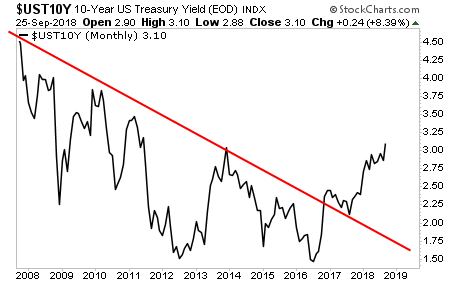
The yield on the 10-year Treasury bond, the single most important bond in the world, has broken a multi-decade downtrend. If this does not reverse soon it means the 30+ year bull market in bonds is over.
UST10Y Monthly Chart
————————————————-
Who said getting rich from trading was hard?
Since inception in 2015, this trading system has produced average annual gains of 41%.
And it’s doing this with just one trade once per week. In fact we just closed a 15% gain last week. And we only held it 24 hours!
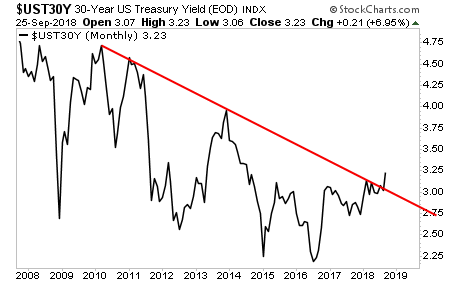
Even worse, a similar pattern is emerging in the 30-year US Treasury.
UST30Y Monthly Chart
Again, this is a massive deal. And while 99% of investors are focusing on stocks… it is bonds that are flashing a major warning. The whole situation is getting eerily similar to late 2007. And now, like then, the vast majority of investors have no clue how to invest during the coming crisis . Which is why smart investors who put capital to work here stand to make fortunes.
On that note, we are putting together an Executive Summary outlining all of these issues as well as what’s coming down the pike when the Everything Bubble bursts.

Canada PM says won't be rushed on NAFTA, new deal not guaranteed

Canadian Prime Minister Justin Trudeau on Wednesday said he would not be rushed into renewing NAFTA and indicated it was possible the three member nations might fail to conclude a new pact.
The top U.S. negotiator on Tuesday complained Canada was not making enough concessions in bilateral talks to renew the North American Free Trade Agreement and said time was running out before Washington proceeded with a Mexico-only deal.
"We will keep working as long as it takes to get to the right deal for Canada," Trudeau told reporters when asked about the increasing U.S. pressure to wrap up the talks.
Asked about the challenges posed by a U.S. threat of auto tariffs, Trudeau said Canada would need to feel confident "about the path forward as we move forward - if we do - on a NAFTA 2.0."
Trudeau also said the tariffs that Trump imposed on Canadian steel and aluminum in late May would have to be scrapped before Canada felt comfortable signing a new NAFTA.
The Trump administration has said the text of an agreement between the three nations is needed by Sunday to allow the current Mexican government to sign it before it leaves office at the end of November

Tapering of asset purchases could start as soon as this year, says Fed’s Daly

https://www.ft.com/content/e3320366-02f1-453e-ae42-e4af66a17eb0 Top central bank official points to strong recovery in US economic activit...